Superhero Crime Open World War
- 4.5
- Rating
- 1.00M
- Installs
- Free
- Price

 Analysis by App-foxy
I went into Superhero Crime Open World War expecting a quick superhero distraction, but its main appeal became clear almost immediately: it puts me in an open-world crime adventure built around Doctor Octopus. That single idea shapes the whole experience. Instead of moving through a short sequence of fixed stages, I get a city-like playground where the fun comes from deciding what to do next, testing the character’s abilities, and creating my own rhythm between action and exploration.
The game is free to download, aimed at Everyone, and belongs to the adventure category. It comes from PSV SANDBOXES TEKNOLOJI ANONIM SIRKETI, and its audience is already substantial, with more than a million installs and an average score of 4.6 from roughly 4.9 thousand ratings. Those numbers do not automatically make a game good, but they do match my impression that this is designed to be immediately approachable rather than demanding or complicated.
My recommendation is fairly specific: this is best for someone who wants casual superhero chaos in a free-roaming setting, not for someone searching for a carefully written comic-book campaign or a deep simulation. The open-world format is the capability worth focusing on, because it changes how I play. I am not simply following one narrow path; I am using the environment as a place to experiment, cause trouble, and return for short sessions.
You May Also Like

 Blood Strike: 2.5 Anniversary
Blood Strike’s Loadouts Turn Every Drop Into a Tactical Gamble
A close look at Blood Strike’s custom loadouts: how fast access to signature weapons reshapes its battle royale rhythm, rewards preparation, and narrows the gap between fights.

 Pandora - Music & Podcasts
Pandora’s Music Is Easy to Start, but Harder to Recover
Pandora’s strength is its low-effort path from a seed to a station. Its weak spot is how much confidence it asks you to place in connection, setup, and quiet recovery.

 8 Ball Pool
 Is Built on Rivalries, Rematches, and Routine
A close look at the rivalries, rematches, shared routines, and unanswered safety questions that turn a quick pool match into a persistent mobile community.

 Samsung Music
’s Quiet Strength Is Playing What You Already Own
Its reach comes less from spectacle than from dependable access to a personal library. That simplicity is both the app’s strongest retention engine and its ceiling.

 AccuWeather: Weather Radar
AccuWeather Review: A Quick, Clear Forecast for Everyday Decisions
For everyday plans, the best forecast is the one you can understand quickly. AccuWeather makes rain timing, radar, and local conditions easy to act on, with a few trade-offs.

 Hill Climb Racing
Why Hill Climb Racing Still Turns Crashes Into One More Run
A tiny car, a bumpy hill and one more upgrade: Hill Climb Racing keeps resurfacing because its simple chaos makes every near-miss feel personal.
More From Our News Desk
View All News


Why the open-world design matters here
In many mobile adventure games, “open world” can feel like a label placed on top of a collection of disconnected activities. Here, the idea works best when I treat the city as a toy box rather than as a realistic world. Doctor Octopus gives the setting its identity, while the crime-focused theme supplies a reason to keep moving and looking for the next bit of action.
The important difference from a conventional level-based superhero game is the freedom to choose my immediate goal. I can spend a session exploring, another session looking for trouble, and a third simply trying to understand how the character behaves in different parts of the map. That flexibility makes the game easier to fit around everyday life. I do not need a long uninterrupted evening to enjoy it.
At the same time, the open format creates a responsibility for the player. If I expect every minute to be guided by a strong story beat, the experience can feel loose. The game is more successful when I bring my own curiosity to it. I enjoy it most when I ask myself what happens if I approach a situation differently, take a less direct route, or use the surroundings as part of the fun instead of rushing from one objective to another.
The real strength is player-directed momentum. The game does not need to convince me that every activity is a major event. It gives me a setting where small choices can become entertaining moments. That is a good fit for mobile gaming, where a short, self-contained burst of action can be more valuable than a long story sequence that I have to remember later.
Doctor Octopus gives the sandbox a clear identity
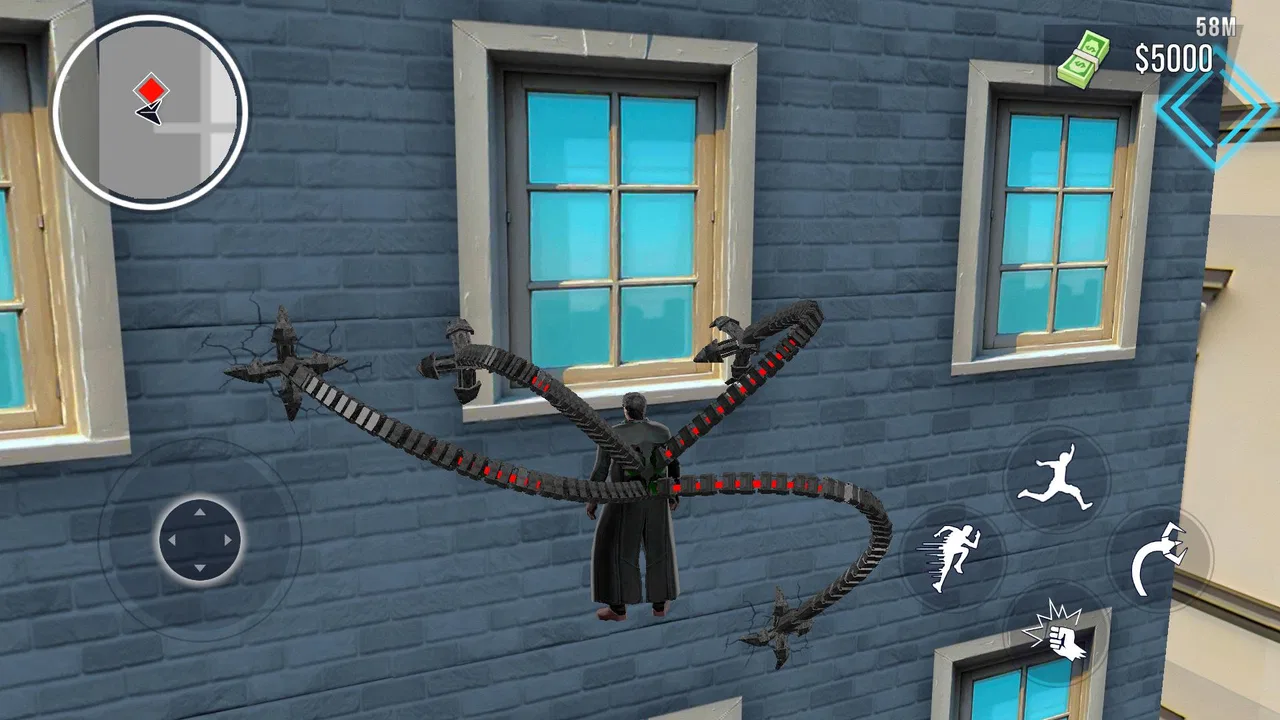
The choice of Doctor Octopus is more distinctive than using an anonymous superhero. His mechanical-arms concept naturally supports movement, combat, and visual spectacle, even when I am only experimenting with the environment. It also gives the game a slightly mischievous tone. I am not playing a restrained hero who carefully avoids every bit of destruction; I am controlling a character whose presence is meant to make the world feel unstable and energetic.
That identity matters because open-world games can otherwise become interchangeable. A generic hero running through a generic city would not give me much reason to remember the experience. Doctor Octopus makes the premise easier to recognize, and the crime setting gives the free-roaming structure a simple purpose: find action, respond to conflict, and enjoy the resulting disorder.
I would not approach this as a detailed character study. The appeal is physical and immediate rather than literary. The character works as a tool for playful movement and superhero-style mayhem. If that is what I want from a mobile game, the concept carries the experience effectively. If I need emotional storytelling, nuanced villains, or a carefully developed comic-book universe, I would look elsewhere.
What playing it feels like in practice
My preferred way to play is to begin without a rigid plan. I move through the world, see what catches my attention, and let the next encounter decide the direction of the session. This approach makes the game feel less like a checklist and more like a short improvisation. The open-world capability has value because it gives me room to make those choices rather than forcing every action into a preset order.
A useful habit is to separate exploration from objective chasing. When I focus only on completing the next task, the world can become background scenery. When I slow down and treat movement as part of the game, I notice more opportunities to test the character and understand the layout. That does not require a complicated strategy; it simply means resisting the urge to hurry through every moment.
I also found that the game suits alternating play styles. On one day, I may want active crime-themed action. On another, I may prefer to wander for a few minutes and see what happens. That variety is more important than it sounds. It prevents the game from feeling like a single repeated challenge, although players who need constant novelty may still notice repetition sooner than they would in a larger premium adventure.
The best everyday scenario
The strongest use case is a short break when I want something more interactive than scrolling but less demanding than a serious console-style game. Imagine having a few minutes before leaving home or while waiting for an appointment. I can open the game, enter the world, create a little superhero chaos, and stop without needing to complete a long chapter. The free-roaming format makes that kind of session feel purposeful even when it is brief.
It is also a reasonable choice for younger players who enjoy superhero themes but do not want a complicated control scheme or mature presentation. The Everyone age rating makes the game easier to consider for a shared family device, although I would still check how comfortable a child is with its crime-themed action. The tone is more playful than serious, but the premise is still built around conflict.
For me, another good scenario is using it as a palate cleanser between larger games. I do not have to remember a complex plot or maintain a carefully optimized build. I can simply return to the open world and play by instinct. That low commitment is one of its most practical advantages.
Where it differs from usual adventure alternatives
Compared with a linear superhero game, this one gives me more freedom but less guaranteed pacing. A story-driven alternative may deliver stronger missions, more polished character development, and a clearer sense of progression. This game answers a different need: it lets me create small moments of action without waiting for the narrative to authorize them.
Compared with a realistic open-world crime game, it is easier to approach and more focused on superhero fantasy. I am not choosing it for realism, detailed social systems, or a grounded depiction of crime. I am choosing it because Doctor Octopus turns the setting into a playground. That distinction helps set the right expectations before downloading it.
It also differs from an endless runner or a standard arena brawler. Those games often give me a tightly controlled route or a compact combat space. Here, the attraction is the space between events: deciding where to go, how long to stay, and whether exploration itself is worth my attention. Players who prefer instant, score-based rounds may find the open world slower than they want.
Practical trade-offs before installing
The biggest trade-off is freedom versus structure. I appreciate not being pushed through one exact sequence, but I also have to supply some of the motivation myself. If I play while tired and expect the game to constantly surprise me, the loose design may feel less satisfying. It works better when I am in the mood to experiment.
Another consideration is the free-to-play model. The game costs nothing to start, while optional in-app purchases are listed at around forty-nine cents per item. That makes trying it low-risk, but I still prefer to decide in advance whether I want to spend anything. The best way to evaluate the game is to first see whether the basic open-world loop holds my attention without treating purchases as part of the initial plan.
The current version is 11.0.0, and the game runs on Android devices using version 7.0 or later. That makes it accessible to many older compatible phones, though actual comfort will still depend on the device and how smoothly it handles a busy open-world scene. I would leave some storage and battery awareness for any game built around continuous movement and action, especially if I plan to play for longer stretches.
The game’s rating is another useful signal, but I would interpret it carefully. A 4.6 average from thousands of ratings suggests that many players find the concept enjoyable, yet it does not guarantee that the same design will suit everyone. A player who wants deep progression may be disappointed even if the game is technically fun. Ratings are most helpful here as confirmation that the basic idea connects with a sizeable audience, not as a promise of a particular experience.
Small habits that improve the experience
My first tip is to avoid judging the game after only a rushed opening session. The open-world design needs a little time to make sense because its appeal comes from the relationship between movement, exploration, and spontaneous action. I get more from it when I allow myself to play without immediately asking whether it feels like a traditional mission game.
Second, I recommend using different session goals. One session can be about learning the environment, another about seeking conflict, and another about simply roaming. This prevents me from measuring every moment by the same standard. It also reveals whether I genuinely enjoy the sandbox or only like the initial novelty of the superhero theme.
Third, I would treat the character as the center of the experience rather than the setting alone. The city matters because it gives Doctor Octopus room to act. If I only admire the map and ignore the character’s movement and abilities, I miss the reason this particular open world exists. The most entertaining moments come from combining where I go with how I choose to behave there.
Finally, I would not spend money immediately. Since the game is free to begin and individual purchases are inexpensive, there is no reason to decide before understanding the basic loop. Play first, identify what you actually enjoy, and only then consider whether an optional item adds enough value to your own routine.
Who should play it and who should skip it
I think this is a good match for casual adventure players, superhero fans who like Doctor Octopus, and anyone who enjoys creating their own small action scenarios. It is especially suitable for people who value freedom over a tightly scripted campaign. The one-million-plus install figure shows that the premise has found a broad audience, but the more useful question is whether I enjoy unstructured play.
I would recommend skipping it if my priority is a serious superhero narrative, precise competitive combat, or a highly realistic crime simulation. I would also be cautious if I dislike free-to-play games on principle, even though the entry price is free and purchases are optional. A linear alternative may be better if I want every session to provide a clearly defined beginning, middle, and conclusion.
Parents considering it for a child should remember that the Everyone rating describes the broad age suitability, not a guarantee that every player will respond to the same action themes in the same way. I would let the child try it briefly and see whether the open-world freedom is enjoyable or simply confusing. The game is accessible, but accessibility and personal preference are not identical.
My final take after spending time in the sandbox
Superhero Crime Open World War succeeds when I use it as a playful Doctor Octopus sandbox rather than demand that it behave like a premium superhero epic. Its defining capability, the open-world setting, gives short sessions a useful sense of choice. I can explore, look for trouble, and create my own pace instead of following one fixed route every time.
That freedom comes with a clear limitation: the game cannot provide all of the motivation for me. Its loose structure may feel repetitive or empty to players who need a strong campaign and constant progression. The free-to-play model also deserves sensible boundaries, even with purchases priced at around forty-nine cents per item.
For my own use, I would keep it installed as a casual adventure game for quick bursts of superhero action. It is free, broadly accessible, and specific enough to stand apart from anonymous open-world clones because Doctor Octopus gives the chaos a recognizable personality. If I approach it with realistic expectations, it is an enjoyable way to turn a spare few minutes into a small, self-directed crime-fighting—or crime-causing—adventure.
FAQs for Superhero Crime Open World War
01What is Superhero Crime Open World War about?
Superhero Crime Open World War is an action-packed game that allows players to assume the role of a superhero in a sprawling open world. Players can engage in thrilling battles, complete missions, and explore a vibrant city while tackling crime and saving the day from various threats.
02What are the system requirements for Superhero Crime Open World War?
To ensure a smooth gaming experience, Superhero Crime Open World War requires Android 7.0 or iOS 11.0 and above. The game also needs at least 2GB of RAM and 1.5GB of free storage space. A device with a powerful processor and GPU is recommended for optimal performance.
03Can I play Superhero Crime Open World War offline?
Superhero Crime Open World War offers offline gameplay, allowing players to enjoy most of its features without an internet connection. However, certain functionalities, like updates and multiplayer modes, require online access to provide an enhanced gaming experience.
04Does Superhero Crime Open World War support multiplayer?
Yes, Superhero Crime Open World War supports multiplayer modes. Players can team up with friends or engage in battles against others in real-time. This feature enhances the interactive experience, allowing players to strategize and compete within the expansive game world.
05Are there in-app purchases in Superhero Crime Open World War?
Superhero Crime Open World War includes in-app purchases that allow players to buy various items, upgrades, and customizations. While the game offers a substantial amount of content for free, these purchases can enhance the experience by unlocking additional features and resources.
Pros
- Immersive open-world experience
- Variety of superhero abilities
- Engaging storyline missions
- High-quality graphics and sound
- Frequent content updates
Cons
- Occasional performance lags
- Some in-app purchases are pricey
- Limited character customization
- Can be repetitive over time
- Requires constant internet connection

Superhero Crime Open World War
Gallery